


What Makes a 50 Freestyler Fast in 2026?
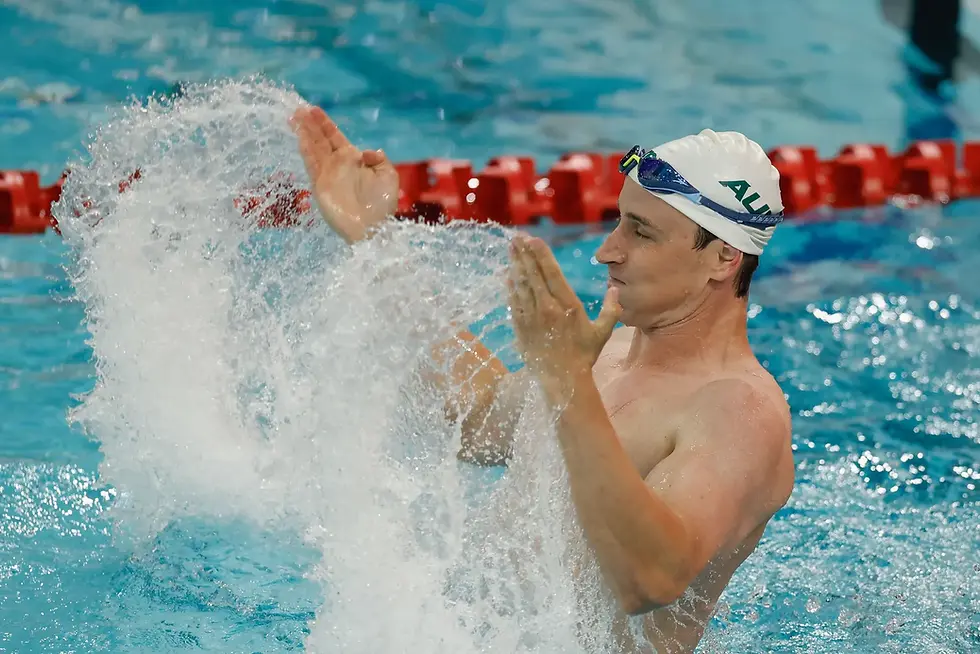
Twenty point eight eight seconds. That is now all it takes to swim 50 meters faster than
anyone in history.
In March, Australian Cameron McEvoy broke one of swimming’s longest-standing world
records, swimming a 20.88 in the 50-meter freestyle and beating Cesar Cielo’s 20.91 from 2009. The difference was only three hundredths of a second. In an event that short, however, three hundredths can come from almost anywhere: a slightly better reaction, a cleaner entry, one stronger kick underwater, a better breakout, or a stroke that holds water just a little more
effectively.
That is what makes the 50 freestyle unique. It looks like swimming’s simplest race; dive
in and go as fast as possible, but by 2026, the event has become a highly specialized combination of power, technique, and efficiency. The best sprinters are not just the swimmers who can move the fastest. They are the swimmers who lose the least speed.
The first place to look is the start.
Research analyzing elite 50-meter freestylers has found that the section from the start
through 15 meters produces one of the largest differences between faster and slower swimmers. That makes sense: the dive is the only part of a swimming race where an athlete can generate force against something solid. Once a swimmer leaves the block, everything becomes a battle against water resistance.
A great start is therefore more than having a quick reaction time. Sprinters need enough
explosive power to leave the block with speed, enter through a small opening in the water, hold a tight streamline, carry that velocity underwater, and transition into swimming without slowing themselves down. An explosive start followed by a poor entry or breakout can waste the speed created on the block.
This emphasis on power has become especially visible through McEvoy. After years as
an elite 100-meter freestyler, he dramatically changed his training to specialize in the 50. Instead of following a traditional high volume swimming program, McEvoy placed greater emphasis on strength, power, short high-quality swimming, and race-specific speed. He has described the 50 as a “strength-based skill,” an idea that challenges the assumption that the best way to become a faster swimmer is simply to swim more.
His results are difficult to ignore. McEvoy won the 50 freestyle at the 2023 World
Championships, became Olympic champion in 2024, won another world championship in 2025, and then broke the world record in 2026.
But power alone does not explain a 20.88.
Once a swimmer reaches the surface, the problem becomes maintaining velocity.
Swimming speed is largely determined by the interaction between stroke rate(how quickly a
swimmer cycles their arms) and stroke length(how much distance the swimmer travels with each cycle). It would seem logical that a 50 freestyler should simply maximize stroke rate. Research on elite swimmers suggests otherwise.
A 2025 study of 324 elite freestyle swimmers found that in the 50-meter freestyle, stroke
length had a stronger relationship with speed than stroke rate alone. The best sprinters were able to use an above-average stroke rate without sacrificing the amount of distance they traveled per stroke. Another analysis of elite 50-meter freestylers reached a similar conclusion: the fastest combination was not necessarily the highest stroke rate or the longest stroke length.
In other words, spinning the arms faster does not automatically make a swimmer faster.
If increasing tempo causes a swimmer to slip through the water, shorten the front of the
stroke, or lose pressure against the water, the extra turnover can become wasted motion. On the other hand, trying to make every stroke excessively long can create dead spots where the swimmer glides and decelerates. Elite sprinting exists between those extremes. The goal is to cycle the arms extremely quickly while still connecting each stroke to the water.
That is also why sprint training can look different from traditional swimming conditioning. Resistance work, short maximal efforts, assisted speed, explosive kicking, and long-rest race pace repetitions allow sprinters to train the movements required at speeds they will actually encounter in a 50. A six-stroke power effort, for example, has a different purpose from swimming an entire 50 as hard as possible. The first develops the ability to produce force
extremely quickly; the second tests whether that speed can be maintained through the race.
The distinction matters because a 50 is technically an endurance event, just an extremely
short one. A swimmer cannot maintain absolute peak muscular power for the entire race.
Speed begins to decay, meaning the winner is often the athlete who manages that decay best.
Research on elite sprint races supports this all-out model. The 50 freestyle typically
begins at enormous speed before gradually slowing. Faster swimmers are not immune to that slowdown. They simply begin faster and preserve more of their velocity through the finish.
That makes the final meters more important than they appear. When two swimmers are separated by hundredths, breathing, body position, kick, stroke timing, and the finish can decide the race. Lifting the head to search for the wall creates drag. Taking an extra short stroke can destroy momentum. Gliding into the wall can be even worse. The fastest finish is the one that allows the swimmer to carry speed directly through the touch.
Put all of these pieces together and the modern 50 freestyler starts to look different from
the stereotype of someone who simply dives in and thrashes for 20 seconds.
The fastest sprinters are powerful enough to create huge speed off the block, technical
enough to preserve it through the entry and breakout, strong enough to hold water at an extreme stroke rate, and precise enough to execute those skills without hesitation. Their training increasingly reflects those demands, with greater attention to power and race-specific quality rather than assuming more yardage automatically produces more speed.
McEvoy’s 20.88 may be the clearest example yet. Seventeen years after Cielo set a record
in the supersuit era, McEvoy finally moved the event forward by three hundredths of a second.
Three hundredths does not sound like much. In the 50 freestyle, finding those three
hundredths is the entire sport.


Wow! Very insightful, Lincoln!